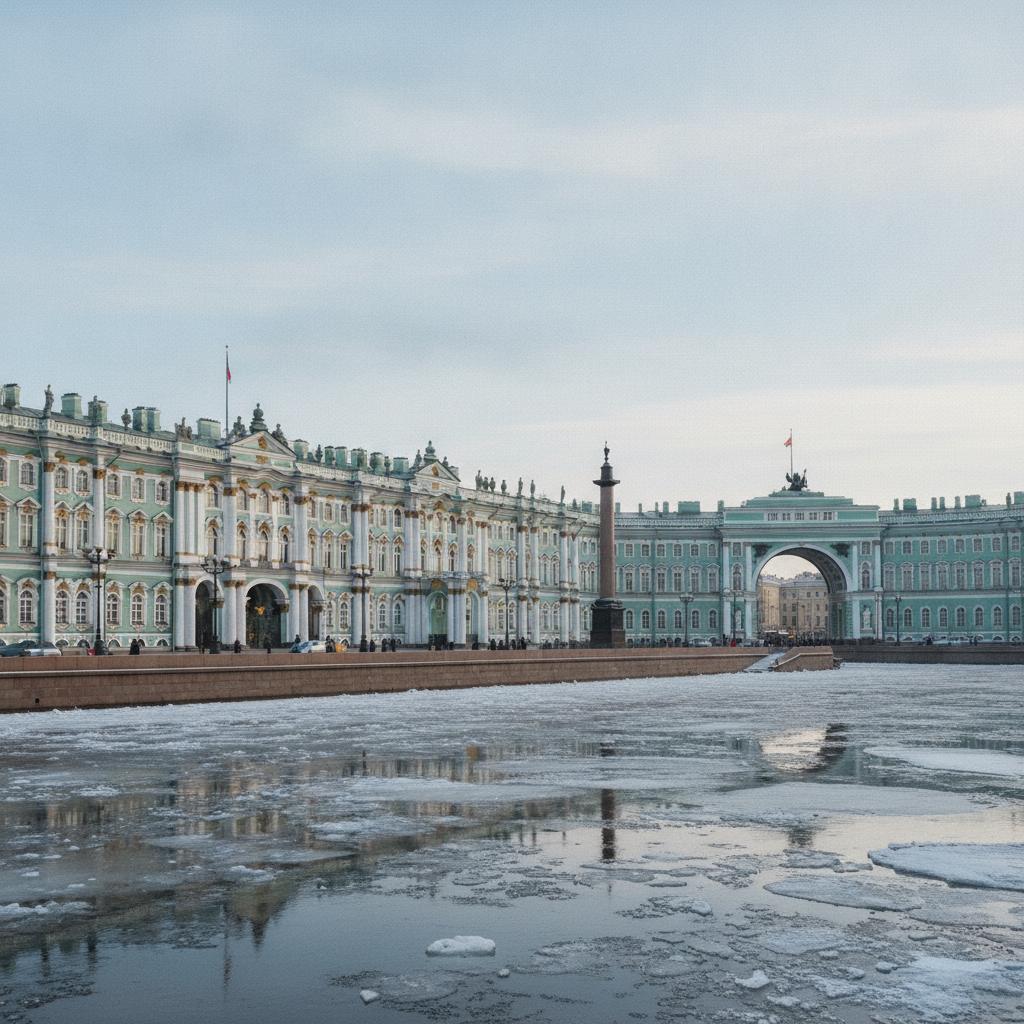
World Museums: Hermitage Museum
Located on the banks of the Neva River in St. Petersburg, often called Russia's "Venice of the North," the Hermitage Museum is one of the world's largest and oldest art and culture museums. The quantity and quality of its collection, combined with the architectural grandeur of its location—the Winter Palace, the former main residence of the Russian Tsars—makes the Hermitage one of the most magnificent structures on the global art scene. Comprising five main buildings, this complex houses more than 3 million works from the dawn of human history to the present day.
The founding of the Hermitage stems from Empress Catherine the Great's (Catherine II) personal passion for art. In 1764, Catherine took the first step of this collection by purchasing 225 paintings by Flemish and Dutch masters from a Berlin merchant. These initial works were kept in the building named "Hermitage," meaning "hermitage" or "retreat" in French, where the Empress's private living quarters were located (the section known today as the Small Hermitage).
Throughout her reign, Catherine ambitiously continued to collect artworks, manuscripts, jewelry, and ancient sculptures. Turning economic difficulties in Europe to her advantage, she purchased numerous collections, and this rapidly growing assemblage soon became one of the largest in Europe. By 1852, under the decree of Tsar Nicholas I, part of the collection was opened to the public, officially establishing the museum. However, its transformation into a massive "museum complex" in the modern sense occurred after the Russian Revolution, when the Winter Palace was incorporated into the collections.
The Hermitage is not just a museum, but also an architectural ensemble of masterpieces. The museum complex is largely an impressive blend of Italian Baroque and Russian Baroque styles.
Winter Palace: It is the main and most magnificent building of the museum. From 1732 to 1917, it served as the official winter residence of the Russian Tsars. Built in the Baroque style, the halls of this palace attract attention as much for their grandeur (such as the Jordan Staircase and the St. George Hall) as for the collections themselves.
Small Hermitage: It is the original structure that housed Catherine's initial collections and gave the museum its name.
Old (Great) Hermitage: Built in 1771 to accommodate Catherine's expanding collections.
New Hermitage: Designed for public visits and opened in 1852, it is the first public museum building. It is famous for the Portico of Atlantes.
Hermitage Theatre: An elegant theater designed for Catherine.
Masterpieces and Depth of Collections
The Hermitage Museum's collections cover a wide spectrum, from prehistoric art to modern art, and from Western Europe to East Asian cultures.
1. Western European Art
The Hermitage is unrivaled, particularly in works from the Italian Renaissance, as well as the Flemish and Dutch Baroque periods.
Italian Renaissance: The museum houses two rare works by Leonardo da Vinci, the Benois Madonna and the Madonna Litta. Important paintings and sculptures by masters such as Raphael and Titian are also exhibited.
Flemish and Dutch Mastery: The museum has one of the largest collections of Rembrandt in the world. Masterpieces like The Return of the Prodigal Son and The Holy Family are the highlights of this section. Large-scale paintings by Rubens and other Flemish painters also attract significant attention.
2. Ancient World and Classical Antiquities
The Hermitage's classical collection is rich in artifacts from Greece, Rome, and especially the Pontic (Black Sea) region. In addition to classical sculptures, the museum houses one of the oldest and most significant collections of Western ceramics.
3. Archaeology and Prehistoric Art
The museum holds invaluable archaeological finds originating from the Asian steppes, renowned particularly for Scythian gold. The Gold Room and the Diamond Room are filled with priceless jewelry belonging to the imperial family, tsarist regalia, and archaeological gold artifacts, forming the most heavily protected sections of the museum.
4. Russian Cultural History
Since the Winter Palace was once the tsarist residence, objects, furniture, and decorative arts reflecting the life and history of the Russian imperial family occupy a substantial space. Magnificent state rooms where official ceremonies took place, such as the Malachite Room, showcase the splendour of Russia's tsarist era.
5. Oriental Arts and Cultures
Due to Russia's geographical location, the Hermitage possesses a highly robust collection of Asian and Eastern cultures. Chinese silks, porcelains, Japanese artworks, and particularly Islamic art pieces from the Near East and Central Asia demonstrate the museum's comprehensive scope.
Beyond being merely an art collection, the Hermitage has witnessed the most dramatic events in Russian history. During the February and October Revolutions of 1917, the Winter Palace became the epicenter of Russia's political life. After the revolution, the palace was incorporated into the collections as a national treasure and opened to the public. During World War II, under the Siege of Leningrad, museum staff evacuated a large portion of the collection to the Ural Mountains, saving them from destruction. After the siege ended, the artworks were brought back, and the museum was swiftly repaired and reopened after the war.
Today, the Hermitage Museum represents not only the splendor of the past, but also Russia's dedication to art and culture. It takes weeks to visit all the halls of this massive complex consisting of six buildings. This is a cultural treasure where every artwork has its own story, pushing the boundaries of art and history.