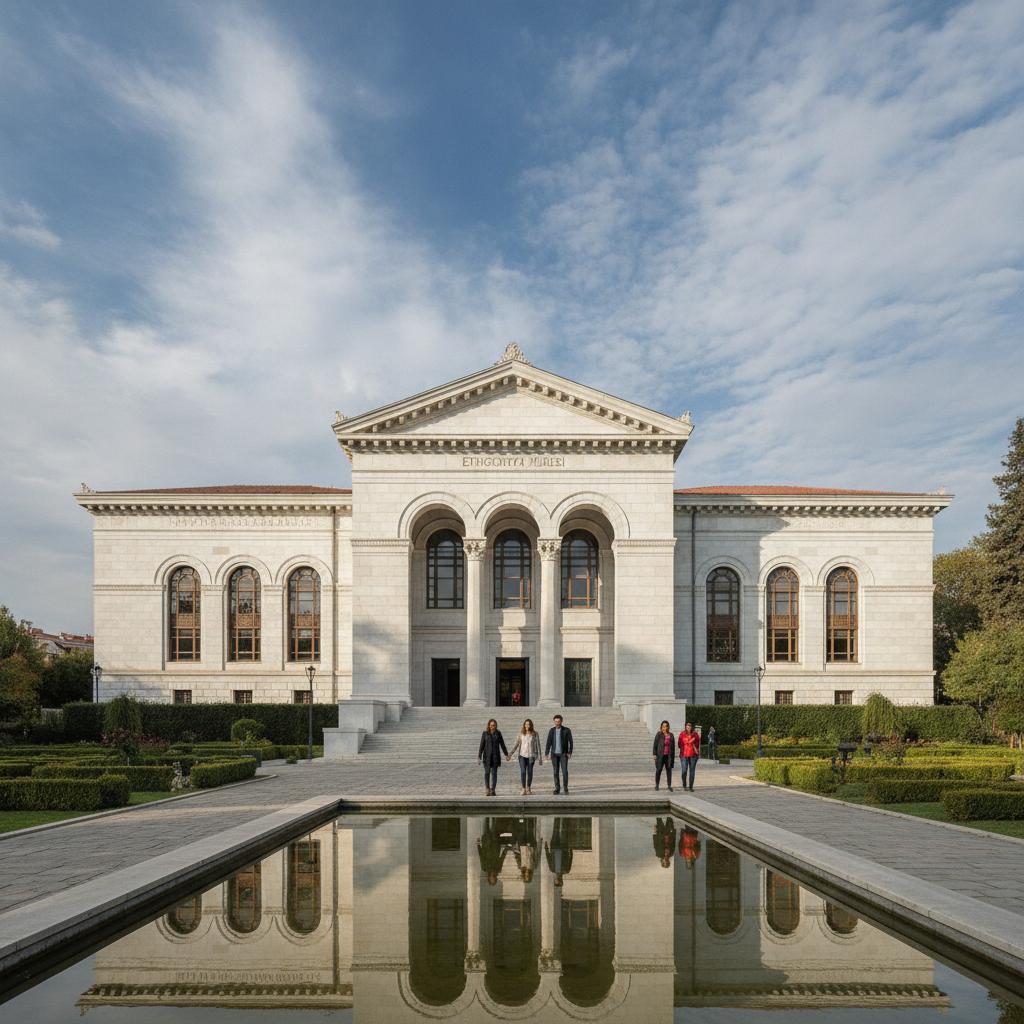
Ankara Ethnography Museum
The story of the Ankara Ethnography Museum begins directly on the instructions of Mustafa Kemal Atatürk. Following the War of Independence, the newly established state needed a space to display its own roots and folk culture with scientific rigor. Designed by architect Arif Hikmet Koyunoğlu, the building was constructed between 1925 and 1928.
The architectural style of the building is one of the purest examples of the "First National Architectural Movement." The marble stairs at the entrance, massive columns, and the elegant dome atop the building carry both the dignity of a palace and the warmth of a community home. Standing in front of the museum, the equestrian statue of Atatürk created by the famous Italian sculptor Pietro Canonica completes the museum's signature presence in the Ankara skyline.
A Fifteen-Year Hosting: Atatürk’s Temporary Tomb
It is not only its collection that makes the Ethnography Museum indispensable for the Turkish nation; it is also a place of deep grief and loyalty. The remains of Mustafa Kemal Atatürk, who passed away on November 10, 1938, were preserved in the inner hall of this museum for a full 15 years, from 1938 to 1953, until Anıtkabir was built.
Today, in the wide open space at the museum's entrance, there is a marble inscription symbolizing the spot where Atatürk’s remains rested for 15 years. While touring this section, you feel that the walls of the museum breathe not only art, but also the longing of a nation for its founder. This fifteen-year "temporary hosting" imparts a spiritual weight to the museum that cannot be found in any other institution.
The Poetry of Wood: Seljuk and Ottoman Craftsmanship
When you step inside the museum, one of the most magnificent sections welcoming you is the masterpieces of Turkish woodwork. The rarest pieces that have survived from the Anatolian Seljuk period to the present day are exhibited here.
In particular, the Minbar of Siirt Grand Mosque is one of the world's finest examples of the intricate and fascinating 12th-century kündekâri (interlocking woodwork without nails) technique. Decorated with patiently crafted geometric motifs and Quranic verses, this minbar demonstrates the power of Turkish art in detail. Similarly, the throne of Seljuk Sultan Ghiyath al-Din Kaykhusraw III, with its delicate carvings that look like petrified wood, is one of the first major reflections of an imperial aesthetic in Anatolia. These works are silent yet dignified witnesses to how great a civilization the Turks built, not only on battlefields, but also in workshops and at looms.
Anatolia Stitch by Stitch: Textiles and Clothing
As you move through the museum's corridors, you enter the famous world of textiles in which Anatolian women embroidered their dreams, sorrows, and joys. Collected from all over Turkey, the carpet and rug collection is like a library of colors. Every motif on the Uşak, Gördes, Bergama, and Milas carpets speaks a language; sometimes a "hands-on-hips" motif tells of fertility, sometimes a "tree of life" speaks of eternity.
In the clothing section, a wide range is offered, from the heavy and magnificent palace garments of the Ottoman period to Anatolia's local "bindallı" and "üçetek" dresses. Each silver thread on the heavily embroidered velvet dress worn by a bride on her wedding morning is actually a document of the social life and aesthetic understanding of that era. The collection donated by Besim Atalay reveals that the Turkish people never disconnected from art, even in their daily lives.
Faith and Art: Calligraphy, Tiles, and Metalwork
The Ethnography Museum also allocates substantial space to calligraphy, one of the most elegant fields of Turkish-Islamic art. Those delicate papers where reed pens meet soot ink represent not only religious texts, but an aesthetic discipline. The handwritten Qurans and diplomas (icazetname) in the museum prove with what elegant language the Ottoman bureaucracy and world of learning kept records.
In addition, silver belts, censers, copper cauldrons, and decorated weapons, which are among the finest examples of Turkish metalwork, welcome visitors in various halls of the museum. Tile fragments surviving from the Seljuk period remind us once again why that famous "turquoise" color is an indispensable element of Turkish art. The brilliant glaze on the Kütahya and İznik tiles still preserves its original vibrancy despite the centuries that have passed.
Why Should You Visit?
Visiting the Ankara Ethnography Museum is not just looking at artifacts like a stranger; it is like opening the chest in the attic of your own home. Here:
-Is a Mirror of National Identity: It is here that you see most clearly how the traditions brought by the Turks from Central Asia reached a synthesis in Anatolian soil.
-Is the First Step of the Republic: It is the first tangible monument to the value modern Turkey places on art and culture. In this respect, the institution is also one of the most important stops in Turkish museology.
-Is a Place of Tranquility and Aesthetics: Away from the noise of the city, you find peace in the warmth of wood within that quiet and dignified atmosphere.
Today, the museum continues to welcome visitors with comprehensive restorations and modern exhibition techniques. Saluting the Ankara Castle, especially with its night lighting, this building is one of the most precious diamonds in the capital's cultural crown.